FirstGroup Targets Reliability Boost on London's Mildmay Line as New Overground Era Begins

New concession operator sets out priorities to improve punctuality, strengthen network resilience and prepare London's Overground for future expansion.
Improving reliability on the Mildmay line has emerged as the immediate operational priority for FirstGroup after taking over responsibility for operating the London Overground network under a new long-term concession.
The operator, through its subsidiary First Rail London, assumed control of the network in May and has identified performance improvements on the Clapham Junction and Richmond to Stratford corridor as one of its first major objectives.
While London's Overground continues to rank among the UK's highest-performing rail networks, Transport for London (TfL) and FirstGroup believe there is scope to narrow the performance gap between the Mildmay line and the rest of the network.
Focus turns to the network's weakest-performing route
During the 2025/26 financial year, approximately 81.6 per cent of Mildmay line services achieved TfL's Time to Three (T3) punctuality target.
Although regarded as a respectable performance by national standards, it remains significantly below the wider London Overground average of 90.5 per cent and well behind the Windrush line, which achieved 93.4 per cent.
With more than 1,600 Overground services operating every day across one of Britain's busiest urban railways, TfL says maintaining consistently high reliability remains a key objective.
First Rail London Managing Director David Statham said bringing the Mildmay line closer to the performance achieved elsewhere across the network would be a major focus during the early years of the concession.
Infrastructure and operational resilience under review
Rather than relying solely on infrastructure investment, FirstGroup intends to combine targeted engineering improvements with enhanced operational management.
Working alongside Network Rail, the company will develop measures designed to improve resilience across the route while introducing more sophisticated contingency planning for periods of disruption.
Greater use of operational data will also play an important role, with on-train monitoring systems expected to help identify infrastructure faults and recurring causes of delay before they develop into larger operational issues.
The operator says strengthening control systems and improving incident response procedures should help minimise disruption when problems occur.
Additional services already introduced
The reliability programme follows the recent introduction of 16 additional peak-time shuttle services operating between Clapham Junction and Shepherd's Bush.
These services use Platform 17 at Clapham Junction rather than the platforms traditionally used by the route, increasing capacity along one of the busiest sections of the Overground network.
The enhancements form part of a broader package of improvements announced when FirstGroup secured the concession, including targeted infrastructure investment intended to improve operational performance on the Mildmay line.
Capacity expansion continues elsewhere
While attention focuses on improving the Mildmay line, TfL is also preparing to expand services on the Windrush line later this year.
From December, frequencies on the central section between Dalston Junction and Surrey Quays will increase from 16 to 18 trains per hour, with two additional services operating to Crystal Palace.
The service uplift is being supported by upgrades at Surrey Quays station, where a new entrance and step-free access are being completed ahead of the timetable change.
TfL believes the additional capacity will accommodate future passenger growth linked to large-scale regeneration projects, including the extensive Canada Water Masterplan development.
Fleet improvements also planned
Attention is also turning to the long-term performance of London's Overground rolling stock.
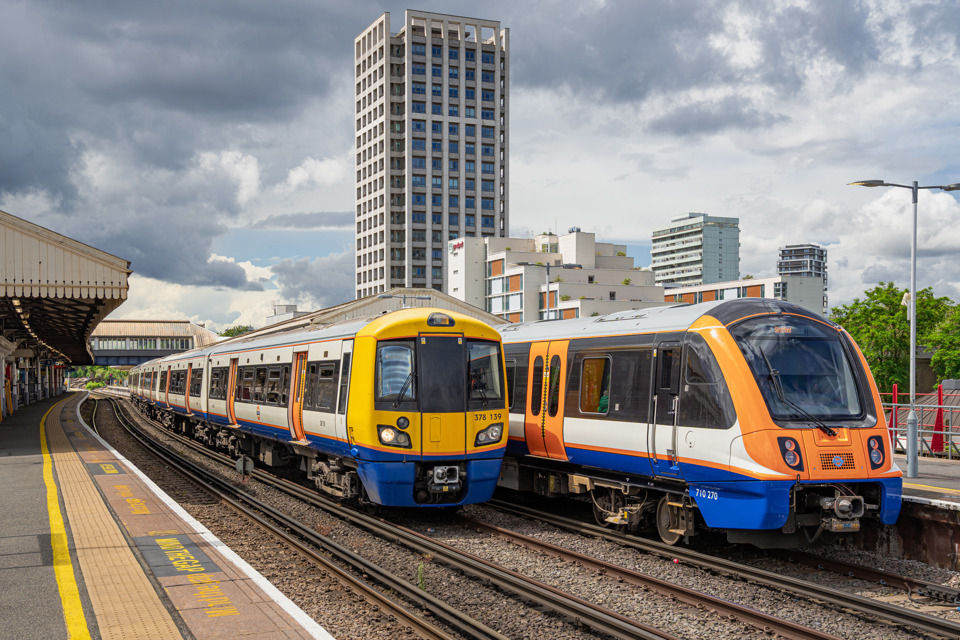
TfL acknowledges that the older Class 378 fleet, now approaching mid-life, requires further reliability improvements despite an ongoing refurbishment programme that includes repainting trains into the latest London Overground livery.
Funding is also being sought to replace the existing driver-only CCTV equipment across the fleet.
Meanwhile, the newer Class 710 trains continue to deliver stronger operational performance, although TfL believes there remains further scope for improvement as the fleet matures.
Preparing for future growth
Beyond improving today's railway, FirstGroup is also looking ahead to significant future expansion.
The planned West London Orbital railway, expected to open during the next decade, will add a new cross-London route between Hounslow and Hendon, creating fresh operational challenges for the concession.
TfL is also continuing discussions over the potential transfer of Great Northern inner suburban services between Moorgate and destinations including Stevenage and Welwyn Garden City, although officials have indicated those routes would sit outside the current Overground concession if devolved.
With passenger satisfaction already exceeding 92 per cent, FirstGroup inherits one of Britain's best-performing urban rail networks. Its challenge over the coming years will be maintaining those high standards while improving the network's weakest-performing routes and preparing London's Overground for its next phase of expansion.


Comments